

No products in the cart.
What Sets a Custom Design Apart from a Standard Design?
Anyone planning a renovation or building a home usually has the same question: Is it really worth investing in a custom design, or is a standard design enough?
This is a question I hear all the time in my day-to-day work.
And my answer almost always starts the same way: it depends on what you expect from your home.
If your goal is simply to fill a space with nice-looking furniture, a standard design might seem like enough. But if you want a home that works for your routine, that’s comfortable and that truly makes sense for the people who live there, then we’re talking about something entirely different.
Throughout this article, I want to show you why that difference goes far beyond aesthetics.
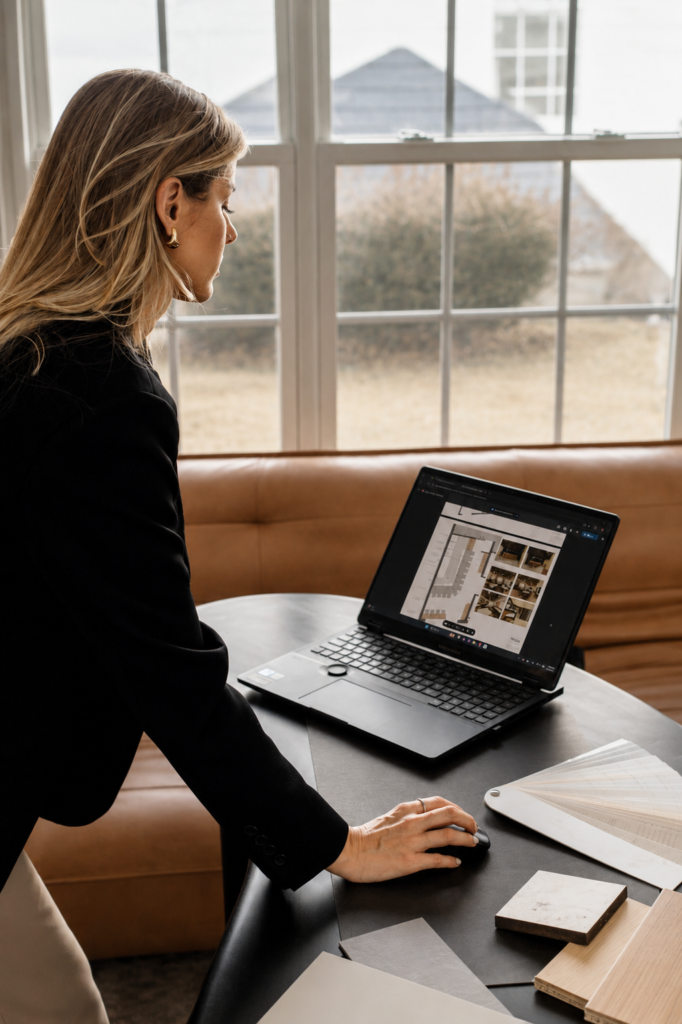
So, what exactly is a standard design?
In short, a standard design is created to appeal to a broad audience. It brings together solutions that work for a lot of people, but that doesn’t mean they’ll work for your specific needs.
In practice, this type of design rarely takes into account the way you actually live your routine, your habits, how many people live in the home, whether you work from home, enjoy cooking, entertain often, or even your budget for the renovation.
The goal of a standard design is to provide a solution that works well for many people. The challenge is that what works for most doesn’t always work for you.
And what is a custom design?
A custom design, on the other hand, goes far beyond aesthetics. The goal isn’t just to create a beautiful space, but to develop one that truly makes sense for your routine, offering more functionality, comfort and practicality in everyday life.
That’s exactly where the main difference lies.
When I start developing a project, my priority isn’t choosing finishes, furniture or colors. Before making any decisions, I want to get to know who will live in that space.
I try to understand the family’s routine, their habits, their priorities and what challenges the space needs to solve.
After all, I believe architecture was never just about spaces. Above all, it’s about people.
Those conversations become the foundation for every design decision. Every detail is designed to reflect the way you live, and that’s what makes a project truly custom.
The design should adapt to your life, not the other way around.
I know a beautiful home catches the eye. But it’s a functional home that makes sense day after day.
It might sound like a small shift in perspective, but a custom design completely changes the way you experience your space.
Think, for instance, about a family that loves to cook and eats most of their meals at home. For them, a well-planned kitchen, with good circulation, countertops at the right height and materials that stand up to everyday use make all the difference.
Now imagine someone who works from home. That person needs a comfortable, quiet space, with proper lighting, designed to support focus and productivity.
See how different these needs are? These are the kinds of needs that rarely show up in a pre-made design. But they make all the difference in the everyday experience of living there.
Every detail is designed to prevent future problems
One of the least visible parts of my work, but also one of the most important, happens before construction even begins.
It’s when I carefully review the design to identify potential conflicts between electrical, plumbing, lighting, cabinetry, and structural systems.
This process is known as design coordination.
In practice, it means solving on paper what could otherwise become a major problem down the road, during construction, when any adjustment already costs more time, money and energy.
It’s much smarter to fix a detail in the design than to have to open up a finished wallafter it’s already built.
A Custom Design Can Also Help Control Costs
There is a common misconception that a custom design project is always the more expensive option. In my experience, the opposite is often true.
When everything is planned from the beginning, decisions can be made more thoughtfully, materials are selected with greater care and purchases happen in a more organized way.
As a result, unexpected issues are reduced.
Most importantly, it helps avoid the kind of rework that so often becomes one of the biggest sources of additional costs during a renovation.
So, Is a Custom Design Worth the Investment?
If you ask me that question, my answer is simple: if your home is important to you and the people who live in it, then it deserves a design that’s tailored to the people who live there.
After all, every family has a different routine.
That’s why I don’t believe in design solutions that treat every home the same way.
My role is to translate each client’s needs, goals and constraints into spaces that truly make sense for the people who will live there.
Conclusion
When we talk about personalized design, we’re not talking about luxury. We’re talking about planning, functionality and thoughtful decisions that make a difference in the way a home is experienced every day.
If this article helped you see design projects from a different perspective, it’s worth exploring my portfolio to see how these ideas translate into real spaces and thoughtful details.
And if you’re currently planning a renovation or rethinking your home, you can count on me to guide you through the process.

Leave a Reply